03
Case Study 03 · Healthcare · Web Design + Development

Dr. Chandril
Chugh —
trust by
design.

A world-class neurologist with 17+ years of training and no digital presence to match. Built from scratch — Figma to live WordPress — for patients across India, the Middle East, and globally.

Design + Development Figma → WordPress Healthcare · Neurology 0 to 1 · Completed drchandrilchugh.com ↗
0→1
Built entirely from scratch
278+
Google reviews surfaced
6+
US certifications presented
Global
Patient reach achieved
01 The Brief

A world-class doctor.
No digital proof.

Dr. Chugh came with one clear ask: "I want to look credible globally." He had 17 years of elite training, six US board certifications, 278+ Google reviews, and appearances in the Economic Times — and a digital presence that matched none of it.

The site needed to work for a patient in Delhi on a slow connection, a diaspora family in the Middle East seeking a trusted neurologist, and a parent in Patna researching pediatric neurology — simultaneously. It also needed a working teleconsultation booking flow.

01
Trust at first glancePatients arriving on a neurology site are often scared. Design must communicate safety before they read a single word.
02
Global without losing localUS credentials for international credibility. Hindi-speaking patients for domestic reach. One site, two audiences.
03
Consultation conversionTurn a worried visitor into a booked appointment — with minimal friction at every step.
04
Performance on low-end devicesMuch of the patient base uses budget Android phones with patchy connectivity.
02 Process

Figma first.
Every decision documented.

I don't build doctor websites the way most agencies do — start with a theme, fill in content, call it done. I started in Figma, mapping information architecture and user flows before designing a single screen.

01

Discovery & IA

Mapped the site structure around patient intent — not Dr. Chugh's credentials. What does a migraine patient find first vs. a parent researching pediatric ADHD?

02

Figma design

Full visual system in Figma — typography, colour, components, all page layouts. Desktop and mobile. Every interaction state specified before opening WordPress.

03

WordPress build

Pixel-accurate implementation with a custom design skin — not a template. Optimised for performance on low-end Android and slow connections.

04

Review & refine

Tested across devices and connection speeds. Iterated on the teleconsultation page based on the real patient booking flow.

03 Design Decisions

Three things that
defined the project.
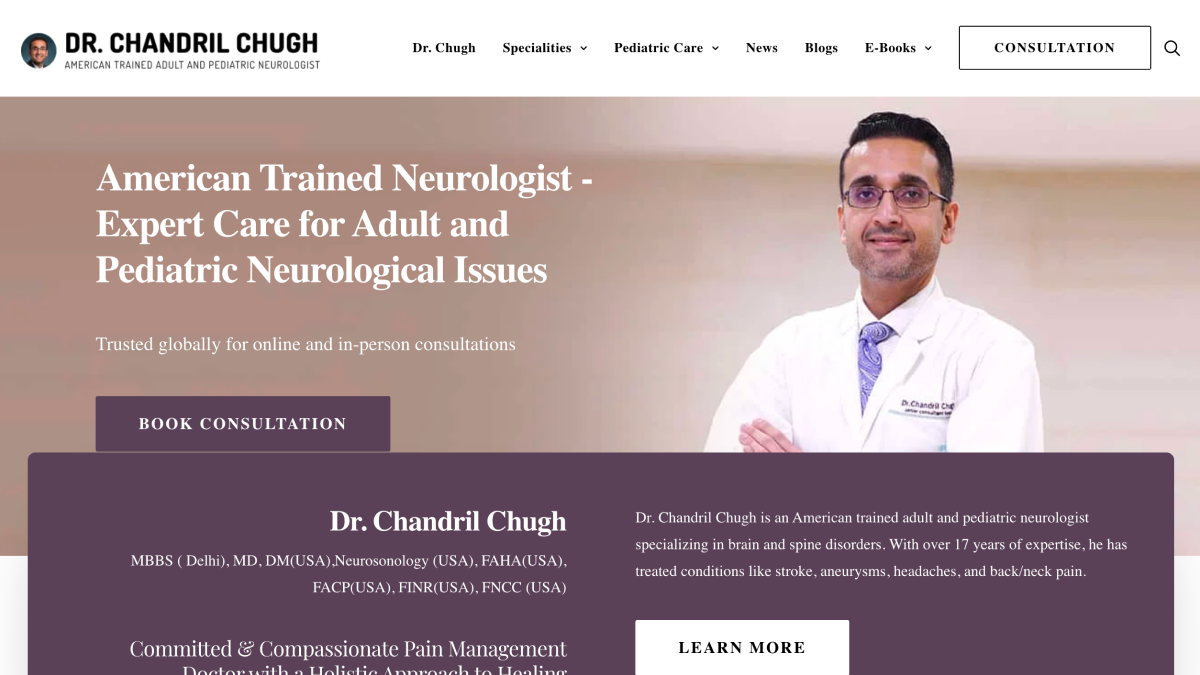
Focus 01
Trust signals & credential architecture
dr chandril chugh website

Dr. Chugh holds six US board certifications. The challenge: display this without turning the homepage into a medical CV patients can't parse. I designed a hierarchy of trust — the hero leads with outcome-focused copy, certifications appear as a compact badge strip, deeper credential detail lives on the profile page for patients who want to verify.

Patient reviews (278+ verified) were treated as a primary trust signal — not relegated to a footer widget. Real reviews in Hindi and English were placed prominently on the teleconsultation page, where anxious and hesitant patients need the most reassurance.

Patients don't book because a doctor has six certifications. They book because they trust the doctor will listen. Lead with empathy, back with credentials.
Trust DesignSocial ProofCredential HierarchyPatient Psychology
Focus 02
Teleconsultation page structure

The teleconsultation page is where an anxious patient decides whether to book or leave. Most medical sites treat this as a generic "services" page. I designed it as a conversion page with a specific psychological flow:

Open with the patient's problem (not the service) → compressed credibility → address the unasked "is online consultation real?" → social proof from patients who've already consulted online → booking options. Three contact methods — WhatsApp, form, phone — given equal visual weight. No forced funnel.

The page answers in sequence: "Is my problem treatable online?" → "Is this doctor qualified?" → "Have others done this?" → "How do I book?"
Conversion UXPage StructureMulti-channel CTAAnxiety Reduction
Focus 03
Appointment flow & CTA design

Medical websites typically have one CTA: "Book Appointment." But patient behaviour is more varied — some want to ask a question first, some want to read more, some are ready to book immediately. Designing a single CTA for all of them means converting fewer of them.

I designed a persistent CTA strategy: a fixed WhatsApp button on every page (fastest path to human contact), a primary CTA in the hero for intent-ready visitors, and a soft secondary CTA for patients still in research mode. The homepage form was kept to three fields only — name, phone, problem — minimising abandonment from form fatigue.

Every page has one primary action. The rest support it quietly. The patient should never have to hunt for how to reach the doctor.
CTA StrategyNavigation DesignForm UXPersistent UI
Design principle

"A doctor's website is not a brochure. It's the first consultation — the moment a patient decides whether they feel safe enough to reach out."

Mohammad Iliyas · Design philosophy
04 What Was Delivered

A complete digital presence —
designed and built.

8+
Purpose-built pages — each with its own intent-specific layout
3
Contact channels — WhatsApp, form, phone — all implemented and tested
2
Patient audiences — adult neurology and pediatric — clearly separated in navigation
0
Generic templates used — custom Figma design, pixel-accurate WordPress build

Global patient reach — India, Middle East, and international patients via teleconsultation

278+ verified Google reviews surfaced as a primary trust signal, not footer decoration

Media credibility (ET, TOI, Business Standard) integrated as recognisable borrowed authority

SEO-structured condition pages — every condition Dr. Chugh treats has a dedicated searchable page

E-book lead magnet for Essential Tremor — building an owned patient email audience

Performance-first WordPress build — fast load on budget Android devices and slow connections

05 Reflection

Healthcare UX is trust design.
Nothing else matters first.

01

Emotional state is a design constraint

A patient on a neurology site is not in the same headspace as someone browsing an e-commerce app. Fear and urgency change how people read, scroll, and decide. Design without accounting for this produces a technically correct site that doesn't convert.

02

Credentials are evidence, not the argument

The argument is: "This doctor will help me." The credentials support it. Leading with evidence before making the argument is a common mistake in professional services design — and why most medical sites feel cold and fail to build trust.

03

Multi-channel CTAs outperform single funnels

Booking a neurologist is not an impulse decision. Patients move at different speeds and through different channels. Designing for the full range of booking behaviours captures patients who would otherwise leave unconverted.

04

Figma-first saves development time

Full design in Figma before touching WordPress meant zero rework during development. Every layout decision, spacing choice, and component state was resolved before the first line of Elementor was placed.

Previous
E-commerce · Beauty
Purplle — India's beauty unicorn
Next
View all projects
Back to portfolio
← Back to all work